WVU School of Nursing faculty recognized with two Chancellor’s Awards for service to West Virginia communities
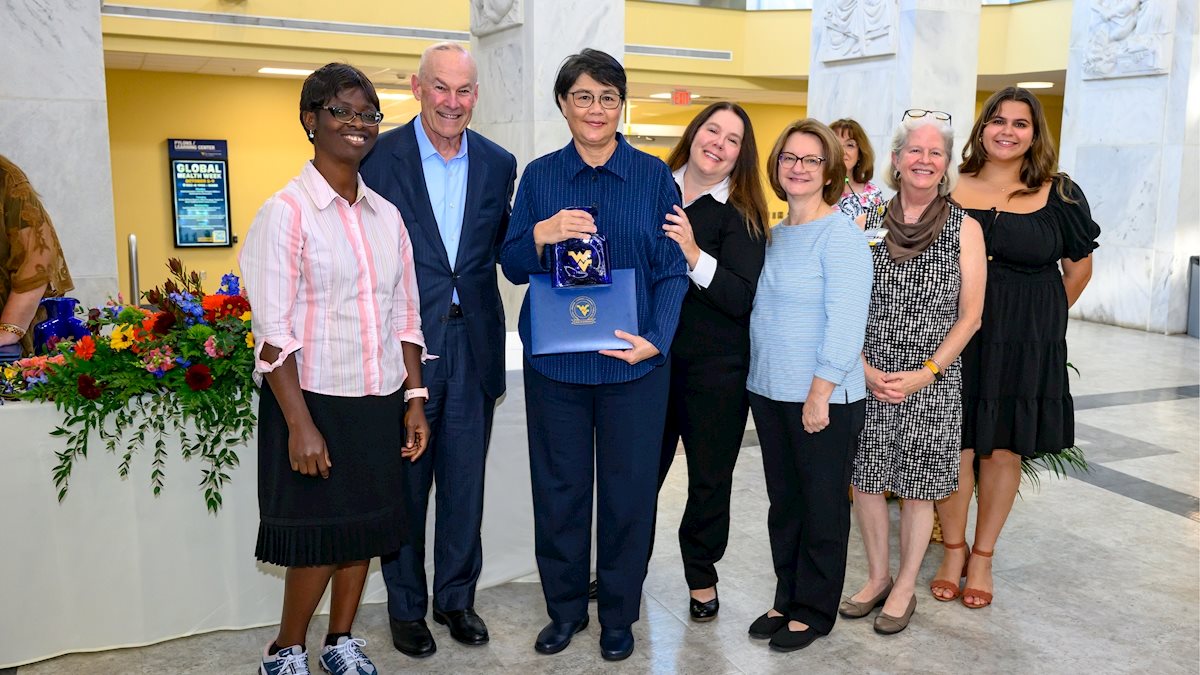
WVU School of Nursing faculty were recognized Oct. 1 with two 2026 Chancellor’s Awards, including the Outstanding Achievement in Local or Regional Service Award and the Community Engaged Team Research Award.
Dr. Angel Smothers, Associate Dean for Community Engagement and Clinical Associate Professor, is being recognized with the Local or Regional Service Award, which recognizes faculty for outstanding achievement in advancing the service mission of WVU Health Sciences at the local or regional level.
For her, the award is about more than an individual accomplishment. It reflects a commitment to service that has shaped her work with communities across West Virginia.
“It is an honor to have received this award. Growing up in an isolated coal camp community in Mercer County, I would have never dreamed of being able to work for WVU, much less receive this award,” Smothers said.
Smothers received the award for her work with nurses across the state, including rural nurses and faith community nurses. Her work has helped build partnerships with community members and organizations while advancing West Virginia University’s land-grant mission of serving communities across the state.

The recognition comes as the WVU School of Nursing continues to expand community-engaged work that connects nursing education and service with the needs of West Virginians. Through the Faith Community Nursing Initiative, nurses are trained to help address gaps in health care access within their own communities.
Dr. Stephanie Young, a Clinical Associate Professor involved in training faith community nurses, said the initiative helps nurses respond to the needs of communities where traditional health care resources may be limited.
“We've been training faith community nurses throughout the state to fill in gaps in healthcare,” Young said.
Faith community nurses can help establish telehealth connections, provide screenings and referrals and connect individuals with resources in their communities.
“Faith community nurses are trusted members of rural communities where sometimes outsiders aren't as welcomed,” Young said.
For Smothers, this community-based approach reflects the role nursing can play beyond traditional health care settings.
Across the School of Nursing, students, faculty and staff participate in community service, helping bring WVU’s land-grant mission into communities throughout the state. Smothers said students should recognize that they are part of that work and take pride in their contributions.
Young agrees that community engagement can give nursing students opportunities to see health care from a different perspective.
“Just helping students see that nursing goes beyond the bedside,” Young said.
The community-engaged work also connects with research being conducted by the School of Nursing faculty.
Dr. Ubolrat “Diu” Piamjariyakul, Associate Dean for Research, led the team recognized with the Community Engaged Team Research Award for an NIH-funded project focused on improving home-based palliative care for individuals living with advanced heart failure and their family caregivers across West Virginia. This award honors faculty research teams who develop effective collaboration with community-based organizations that result in outstanding scholarly and community outcomes.
Their project brought together patients, caregivers, faith community nurses and health care organizations to develop approaches that are practical and culturally relevant for rural communities.
Piamjariyakul said the recognition reflects the work of a much larger group of people, including faculty, staff, students, community partners, faith community nurses and the families who participated in the research.
“Receiving these awards is deeply meaningful to our School of Nursing,” Piamjariyakul said. “While the recognition is certainly an honor, it is really a testament to the collective efforts of our nursing, medical, statistical, economic faculty, staff, students, community partners, faith community nurses, and the families who have generously shared their experiences with us.”
That collaboration is important to the work being recognized. By bringing research and service together, faculty and community partners can develop solutions based on the experiences of the people they serve.
“Research and service are most impactful when they work together,” Piamjariyakul said.
The impact of those partnerships can be seen in the relationships researchers have developed with rural patients and families. Piamjariyakul said the team built trust with communities where participation in health research has historically been limited, allowing patients and caregivers to share their experiences and help shape the work.
For Smothers, that connection between nursing and service is ultimately what makes the recognition meaningful.
“This award is especially meaningful because it recognizes something that is central to both nursing and West Virginia University: service,” Smothers said. “As nurses, we are called to serve others, and as a land-grant institution, WVU is committed to using education, research, and outreach to improve lives.”
The Chancellor’s Awards provide an opportunity to recognize the work already being done across the School of Nursing while encouraging faculty, staff and students to continue finding ways to serve communities throughout West Virginia.
Piamjariyakul said the recognition represents what is possible when different areas of the School of Nursing and its community partners work toward a common goal: “This award represents the extraordinary impact that can be achieved when community, research, education, and service come together with a shared purpose.”

-WVU-
bc/10/6/2026
MEDIA CONTACT:
Wendy Holdren
Director of Communications and Marketing
WVU School of Nursing
304-581-1772; wendy.holdren@hsc.wvu.edu