NeuroEngineering and Rehabilitation Laboratory
At NeuroEngineering and Rehabilitation Laboratory (NERL) we discover functional mechanisms of sensorimotor control and develop objective assessments of movement deficits and motor skills. By studying the dynamics of neural circuits through neuromechanical interactions, we strive to improve the diagnosis and treatment of sensorimotor impairments after neural and musculoskeletal injuries on Earth and in space. Understanding mathematically these neuromechanical interactions will help develop more intuitive human-machine interfaces, understand how motor impairments emerge, and guide the development of new interventions.
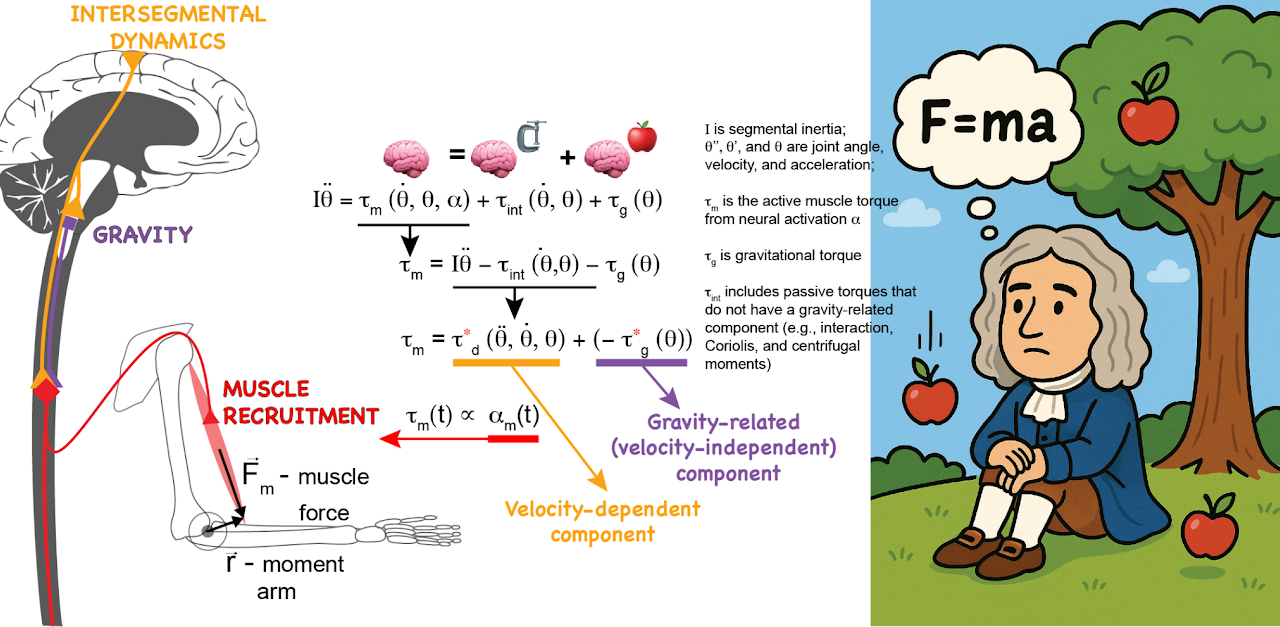
Our multidisciplinary research program comprises computational and experimental studies using non-invasive electromyography, motion capture, transcranial magnetic stimulation, and neuromuscular electrical stimulation used during motion with complex dynamics defined by virtual reality. This setup enables the shaping of human behavior in a way that minimizes noise across individuals while revealing meaningful biomechanical and neurological differences. The analysis of the obtained rich dataset using dynamical musculoskeletal modeling helps derive the functional mechanisms of the neural control of movement and quantify motor deficits caused by stroke and other conditions.
Become familiar with our methods:
- Talkington, W. J., Pollard, B. S., Olesh, E. V., and Gritsenko, V. (2015) Multifunctional setup for studying human motor control using transcranial magnetic stimulation, electromyography, motion capture, and virtual reality. JoVE (103), e52906, PMCID: PMC4692582
- Taitano, R. I., Yough, M. T., Hanna, K., Korol, A. S., and Gritsenko, V. (2024) Setup for the Quantitative Assessment of Motion and Muscle Activity During Virtual Box and Block Test. JoVE: JoVE65736. DOI: 10.3791/65736
Current projects
NASA: BioAISense: Bioinspired Artificial Intelligence for autonomous assessment of Sensorimotor function
The goal is to derive solutions for describing quantitatively, autonomously, and in real-time the individual neuromechanical transformations using AI algorithms and tractable neuromuscular dynamic models.
AFOSR: Multimodal Framework for Sensation to Action Transformation
Major Goals: We propose to test a hypothesis that subdividing the overall complexity of musculoskeletal transformations into sequential dynamic transformations will enable biomimetic simulations of distributed neural processing along the neuroaxis.
Location:
Rooms 149 & 151, Erma Byrd Biomedical Research Facility
West Virginia University, Morgantown, WV, 26506, USA
Phone: (304) 293 7976